
The Long Term Economic Impact of a US Iran War on the Global Economy

When markets hear US Iran conflict, the price of oil rises. And they’re right but only partially. Because oil is just the trigger. The real story is what follows: inflation shocks, supply chain rewiring, capital flight and a structural shift in how the global economy functions.
This isn’t a temporary disruption. It’s a potential macro reset.
The Energy Shock That Sets Off a Chain Reaction
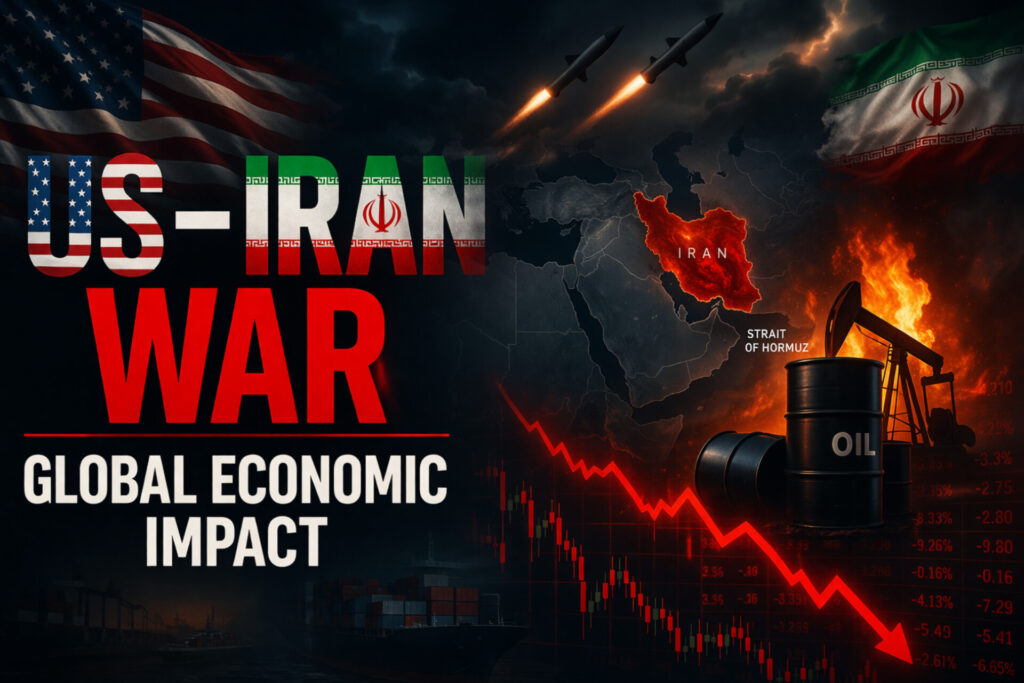
The Strait of Hormuz handles roughly 20 to 30% of global crude oil flows (17 to 20 million barrels per day) and close to 20% of global LNG trade. Any disruption military escalation, blockades or even risk perception tighten supply instantly.
Historical sensitivity is clear. During past escalations, Brent crude has surged 20-40% within weeks, briefly breaching the $100-110 per barrel range. The key risk is a sustained conflict is not the spike but the flow reset. Oil stabilising it elevated levels structure really rises global costs.
Energy feeds into nearly every economic layer transport, chemicals fertilisers and heavy industry. A 10% rise in oil prices typically adds 0.2- 0.3 percentage points to global inflation, according to IMF estimates. The multiplier effect is where the real damage begins.
Inflation Becomes Structural, Not Cyclical
Energy shocks translate quickly into broad based inflation. freightt costs rise, fertiliser prices spike and food inflation follows with a lag. For context, the Middle East accounts for a significant share of global urea exports critical for agriculture.
What starts as a cost push inflation becomes embedded. Businesses pass on higher input costs. Wage demands follow. Inflation expectations de-anchor.
The problem? Central banks lose flexibility.
Tightening monetary policy to control inflation rises borrowing costs, slowing investment and consumption. But not tightening risks inflation spiralling further. This creates a policy trap one that defined the 1970s oil shock era, when global inflation stayed elevated for nearly a decade.
Inflation Explained: Why price rise and what it means for you ( Must Read )
Stagflation Risk Moves From Theory To Reality
A prolonged US Iran conflict materially rises the probability of stagflation high inflation combined with low growth.
Higher energy prices act as a tax on consumption. Households spend more on fuel and food, leaving less for discretionary spending. At the same time, businesses face margin pressure and delay capital expenditure.
Even modest predictions show impact. A sustained oil shock could shave 0.3-0.5% off global GDP growth, which, in $100 trillion global economy, translates into hundreds of billions in lost output.
The real risk isn’t contraction, it’s prolonged stagnation.
Supply Chains Shift From Efficiency to Security
Global supply chains are optimised for costs, not conflict. A war in the Gulf disturbs shipping routes, raises maritime insurance premium and increases fright volatility.
The Strait of Hormuz isn’t just about oil, it’s a gateway for Petro chemicals, metals and industrial inputs. A severe disruption can reduce shipping volumes dramatically and spike logistic costs.
But the long term impact is structural. Firms begin to redesign supply chains:
- Nearshoring production
- Diversifying supplier base
- Increasing inventory buffers
This shift from just in time to just in case rises costs permanently. The result is a less efficient but more resilient global system, effectively reversing decades of hyper globalisation.
Emerging Markets Absorb the Shock
The burden is asymmetrical. Oil importing emerging economies face the sharpest impact.
Take India: it imports over 85% of its crude oil needs. A $10 increase in oil prices significantly widens the current account deficit and adds direct pressure on inflation. Currency depreciation often follows, amplifying imported inflation.
The same dynamic applies across emerging Asia and parts of Africa. In many of these economies, 30-40% of household expenditure is allocated to food, making them highly sensitive to price shocks.
The consequence is not just economic, it’s political. Rising living costs have historically triggered social unrest and fiscal stress in vulnerable economies.
Global Growth and Trade Slow Quietly but Persistently
Geopolitical conflict doesn’t need to escalate globally to affect global growth. Uncertainty alone is enough.
Investment decisions get delayed. Risk premiums rise. Trade flows slow. Higher energy prices reduce consumption, while supply disruption increases production costs. This double squeeze weakens both demand and supply simultaneously. The IMF’s broad framework is simple higher prices + low growth = deteriorating macro stability.
And importantly, recovery takes longer than the shock itself.
Financial Markets Reprice Risk
Markets respond immediately to geopolitical instability. A US Iran war would likely trigger increased equity market volatility, capital inflows into safe haven assets like gold, strengthening of the US dollar, widening credit spreads. Energy intensive sectors aviation, logistics, manufacturing faced margin compressions. Meanwhile, defence and energy stocks may outperform in the short term. Over time sustained uncertainty rises the global risk premium, increasing the cost of capital and reducing investment efficiency across markets.
Energy Strategy Undergoes a Structural Shift
Repeated supply shocks accelerate long term energy transition. Post 2022 (Russia-Ukraine), countries already began diversifying energy sources. A US-Iran conflict would intensify this trend:
1) Increased investment in renewables
2) Expansion of strategic petroleum reserves
3) Diversification of import partners
While fossil fuels remain dominant in the near term, the direction becomes clearer. Reduced dependency on geopolitically volatile regions.
Ironically, sustained oil shocks often act as catalyst for the energy transition.
From Globalisation to Fragmentation
The most profound impact isn’t cyclical, it’s structural.
Geopolitical conflict accelerates the shift toward geoeconomics, where national security considerations override economic efficiency.
This leads to:
Trade realignments
Regional blocs
Supply chain localisation
The result is a more fragmented global economy. Trade becomes less efficient, growth slows marginally and costs remain structurally higher.
Globalization doesn’t disappear but it becomes selective and strategic.
What is Economics? A simple explanation for beginners (Do check it out)